Here are some images of what I am working on at the moment and what’s coming up.
Tealight holders are fun to do and the simpler ones don’t take too long, but adding radiating tool marks when it suits the stone can elevate it from just a piece of stone with a hole in it. My Owl tealight holder is more time consuming as I have to swap the drill bits to get through the stone, and make sure the stone is secured safely before I start to drill. All the drilling has to be carried out on my pillar drill with running water to make sure I don’t burn out the diamond core drill. These pieces of equipment can be quite expensive. The photos are from either side so you can see how effective this is. You may have remembered that I have done some in the past with cave painting in them but I need to get some more stone for this type of creation. I decided to carve the beak and tooling around the holes because I thought it looked like an owl.
I still have about 10 hours work on my mermaid carving. This is a piece of Portland limestone and I drew the design straight onto the stone. If I draw a design in my sketchbook, it is very difficult to re-draw it the same, the only way I can copy it over in this instance is to make a template so I often draw straight onto the stone to get my design how I want it.
These are some of the new pieces that I will be carving over the coming weeks. Obviously I need to work on my commissions too but I hope to have these done before Easter.
I have been struggling to concentrate on my commissions and new pieces as the site gets busier and visitors like to stop me to ask questions. Which is fine and part of working from a visitor attraction. However when my flow is interrupted on a regular basis I lose focus and my work flow begins to suffer.
I have decided to close to visitors during the week except by appointment. I am open as normal to the public at the weekend. This means that I can get on with jobs I have been unable to do, simple jobs like cutting stone for some of my new carvings and sitting quietly designing how words are formed.
I thought you might like to see them before I start the carving process.
Obviously once they are carved I will be sanding the stone and then painting the lettering, I have some beautiful blues for the Mermaid…
Like these bookends which were inspired by swimming in an outdoor pool, something I love to do.
As you can see, the tail of the M has a wave crest and the tail of the a is terminated with a mermaid’s tail.
Serendipity is fluid and sing has almost note forms in the letters.
Each word is designed straight onto the stone and I may rub all or part of it off and re-draw it until I am happy that it looks how I want it to.
Obviously the next stage is to carve it and for that I will take the stone back to my workshop and do that there.
I look forward to showing you the finished carving and my next series of designs.
I am getting ready for some exciting events this year and my theme is Medieval and historical subjects associated with Kent.
The Dragons with knotwork is my own design from a series that I was working on back in 2017. When I first started on my own I used to carve Celtic knotwork taken from historical manuscripts but I always knew that I would eventually design my own and here is one of those designs. This is carved out of Welsh slate from the Horseshoe Pass in North Wales.
The first event this year is a medieval market organised by the Sandwich Medieval Trust. It takes place in St Mary’s Church in Sandwich. I thought it would be fun to design and carve a pair of bookends in the form of a Medieval Cog. These are carved out of French limestone.
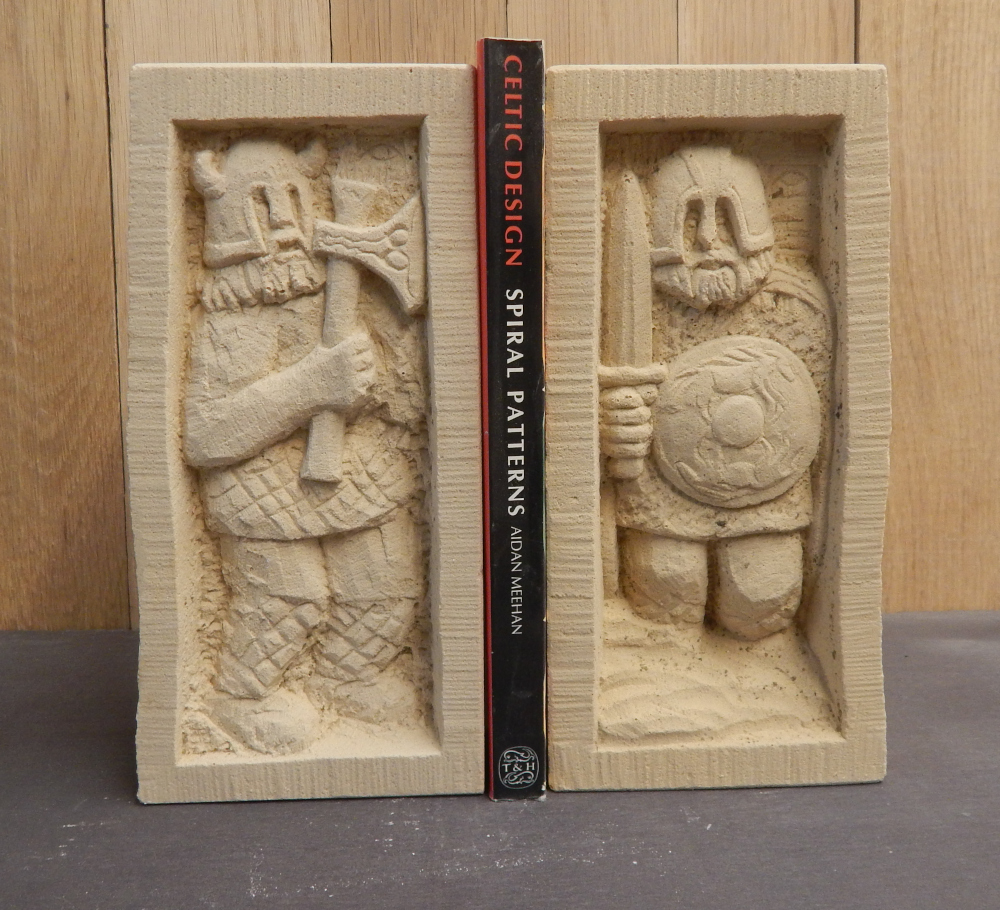
The bookends featuring Hengist and Horsa are hand carved out of Forest of Dean sandstone. They were invited by Vortigern the King of Kent in the 5th C to help him get rid of the Picts and the Scots, they received Thanet as payment but it wasn’t enough. they wanted all of Kent so went to battle. Horsa was slain supposedly in Aylesford. Most of the writing is from 300 years after their escapades so there isn’t alot about them. I have incorporated a horse motif on Hengist’s axe and Horsa’s shield.
The Seashell is synonymous with pilgrims and symbolises St James the Great, this is the Church from the village I grew up in and also the symbol from one of my first jobs at Staple Vineyard. I have carved this out of Welsh slate from the Horseshoe Pass in North Wales.
The final pair of bookends are inspired by my love of swimming in crystal blue water, I used to love swimming in the outdoor pool at my school Sir Roger Manwood’s and still love to swim in the lido local to where I live now. These are carved out of Forest of Dean sandstone.
I am looking forward to collecting my Kentish Ragstone from Maidstone, hopefully this will be ready in time for me to carve some designs and a full alphabet.
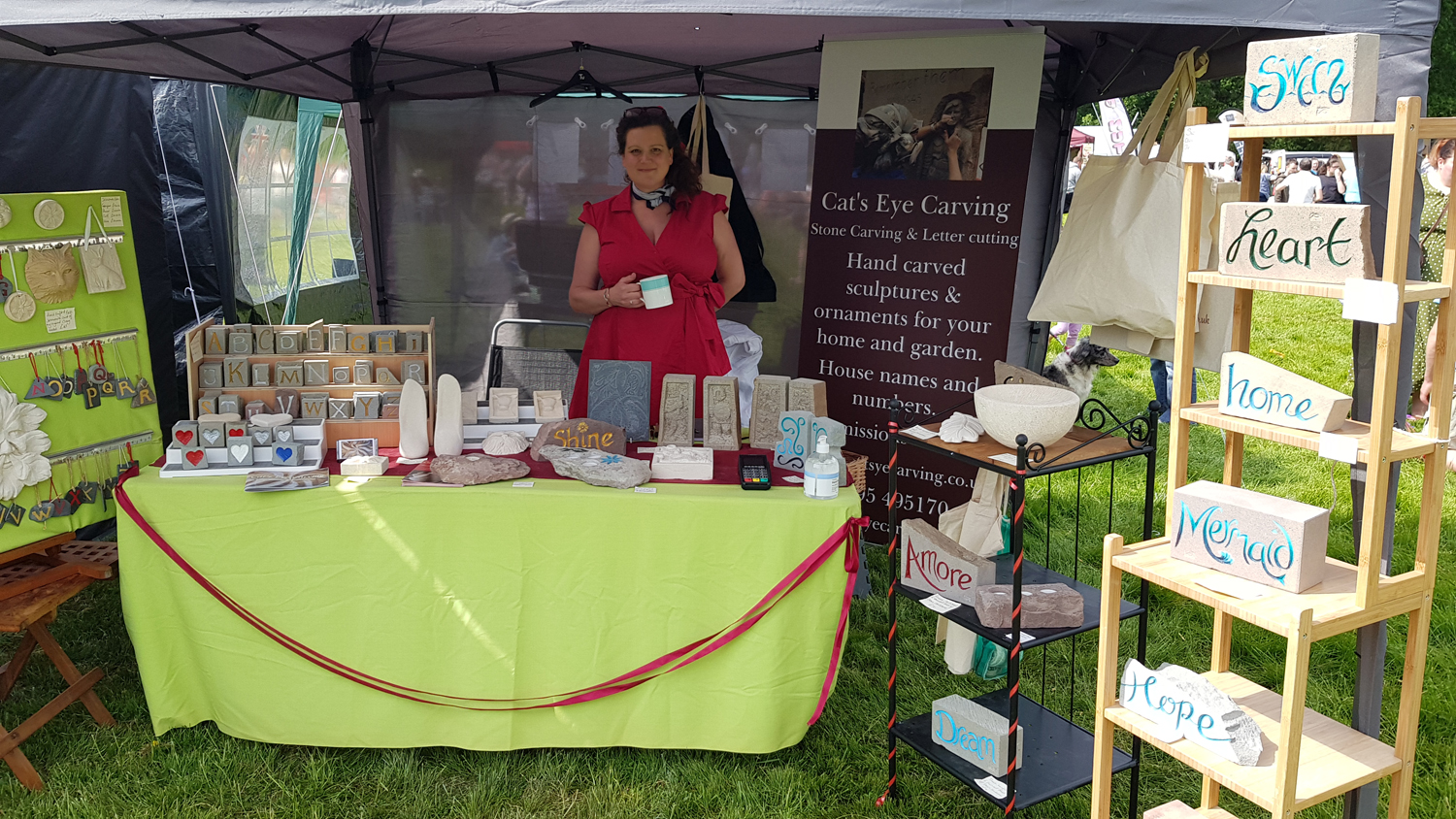
All of these designs and the ones I haven’t carved yet will be available to buy at the events that I will be taking part in this year.
Last November I was notified about a potential commission, one which if I got would have taken me 10 months and would have been an exceptional project to be involved with.
Sadly I didn’t get shortlisted but I thought that I would share my proposal with you. I spent many hours researching and planning, I made a full scale maquette to help me realise how large the sculpture would need to be and to plan my scale drawings.
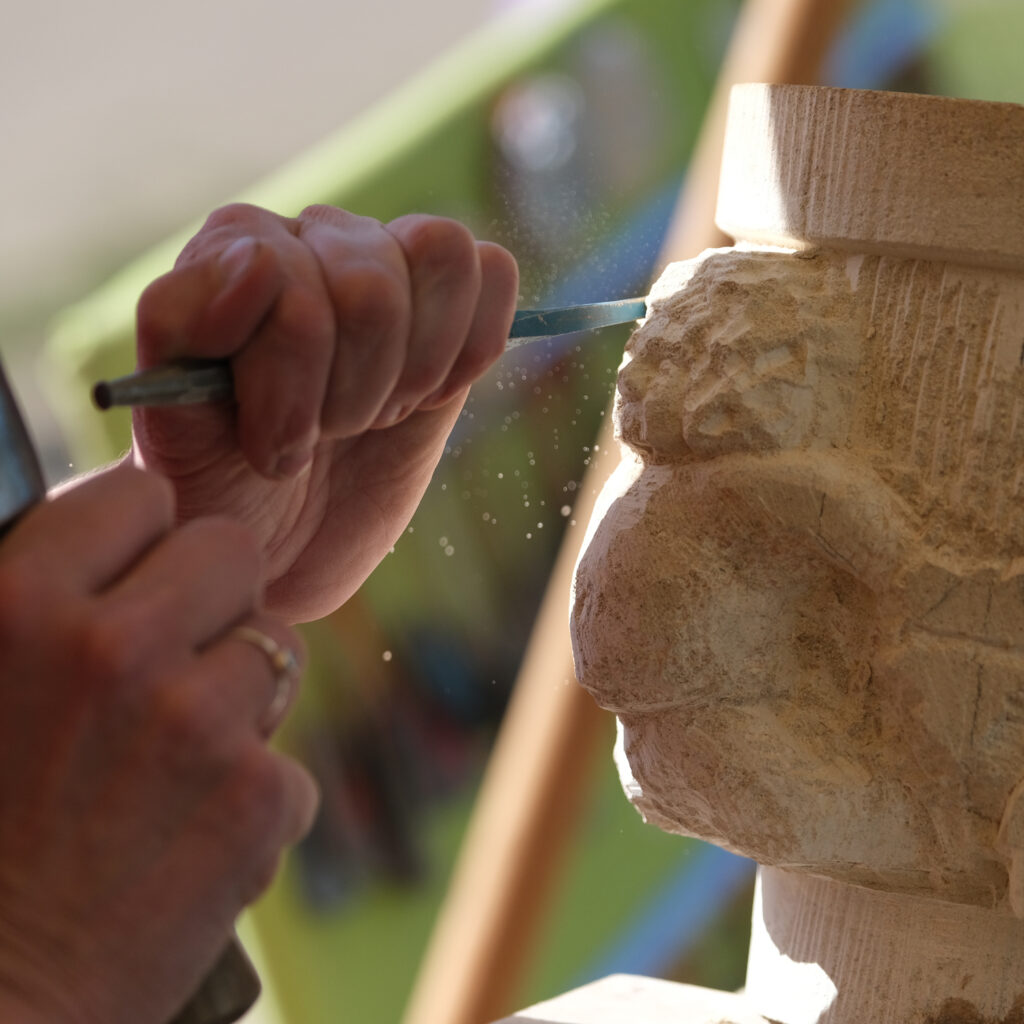
I sculpted it out of Plaster of Paris, built up over a wire frame and polystyrene and then carved it with smal chisels and a scalpel. She had a long nose a large forehead and a double chin but she wasn’t fat. It was the fashion in the 17th Century.
I carved her name in a piece of the French limestone that I proposed using in her handwriting.
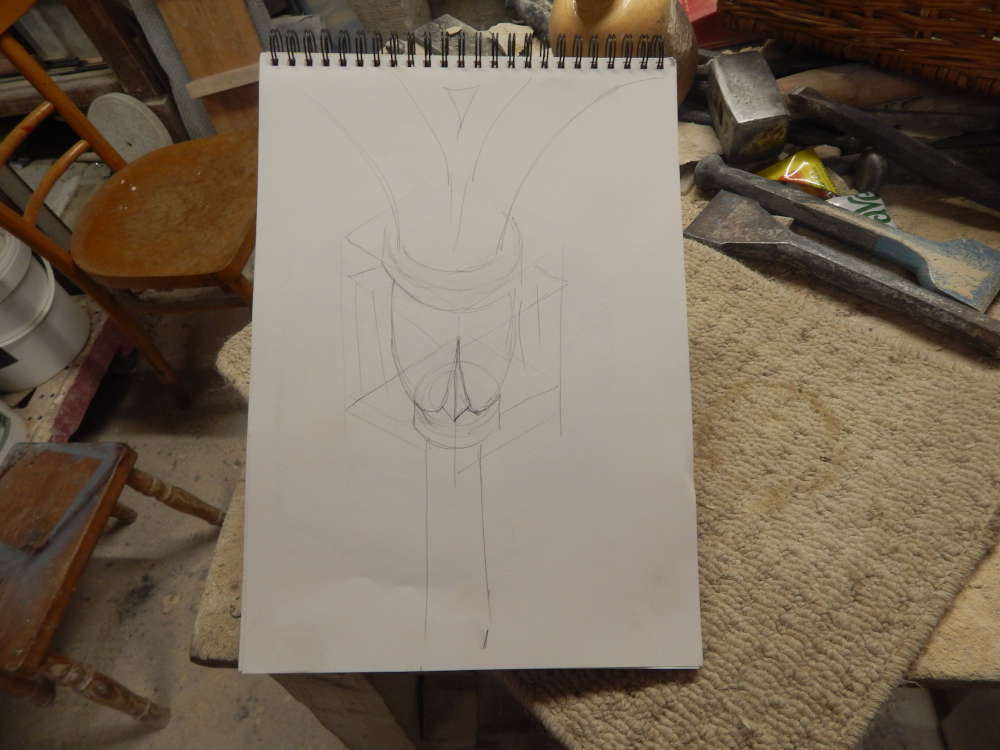
These are my concept sketches and preliminary drawings to work out how she could be represented. I wanted her to be on the same level as the viewers and also to be something people could interact with.
Apparently she liked to sit in inns and write, obviously being able to listen in on conversations to help inspire her writing. I also wanted it to be almost like a stage and somewhere that people could actually sit with her. Part of the design incorporated a stone bench opposite her that you could sit at.
I wanted my statue to look like she was about to strike up a conversation, a bit like my What’s the question? statue that I carved.
The design incorporates 2 walls one carved like an open book with lines from a poem, I would have carved it in her handwriting. There was a porthole in the shape of an ellipse, like her image in her anthology, but you get to look through this and see the statue of Aphra sitting on the other side.
The other wall would have had a small mullioned window that you can see her through, underneath that was a quatrefoil like the ones found at her parish church, St Margaret’s in Canterbury.
This wall would be recessed to give the illusion of quoins stones and I would have built knapped flint into the wall to copy the walls of the buildings she would have grown up with.
Outside walls.
The inside would have had Aphra sitting at a table, her quill resting on the table and her hand around a cup of ale just looking up to speak. I would have carved ‘shelves’ with books on with names of people relevant to her, her contemporaries and people who have been inspired by her, a globe to represent her travels as a spy for Charles II among other objects that would have become more researched as I developed my project and obviously the bench for anyone who wanted to sit down with her.
Inside.
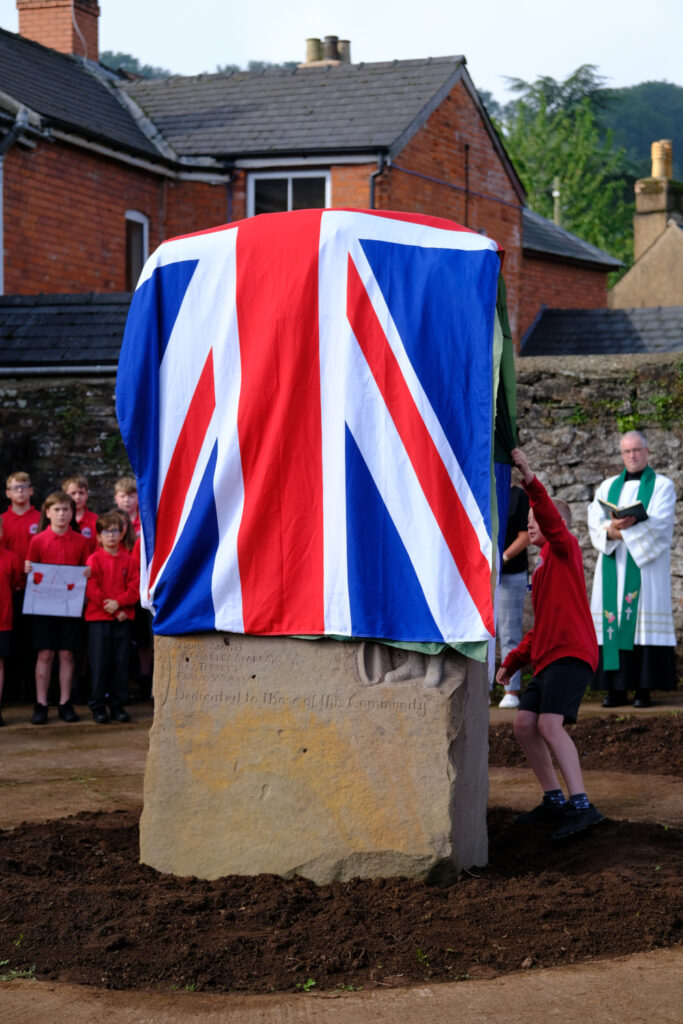
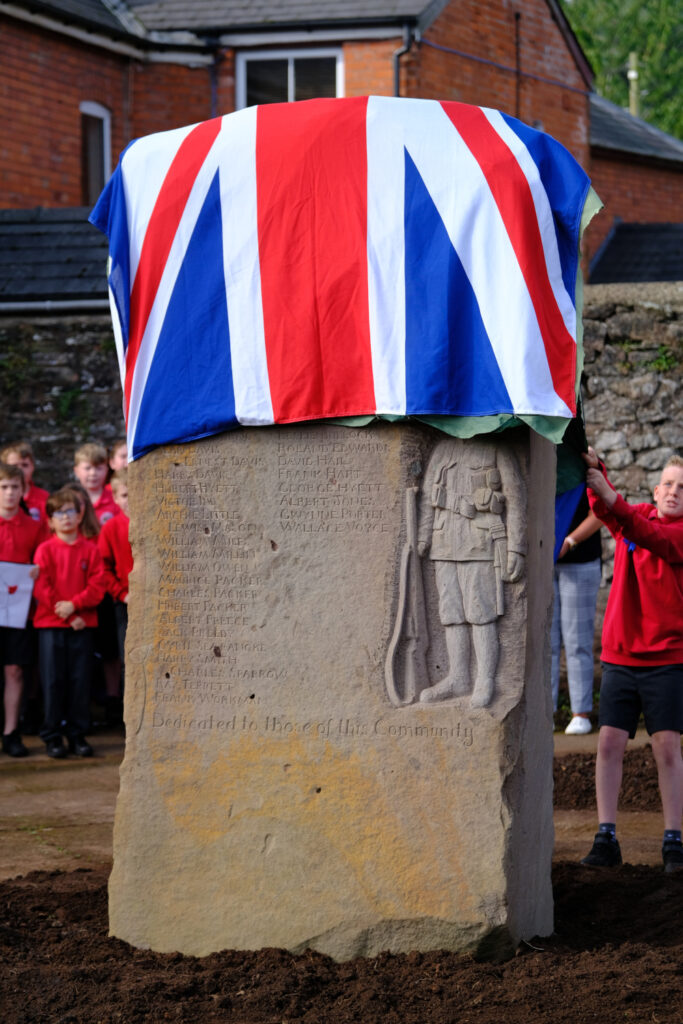
I also shared photos of my war memorial commission as an example of my large scale work.
And photos of my sculpture that I carved for Highgate cemetery.
I submitted this video as my presentation along with my supporting documents. I wanted them to meet me and to get and hopefully understand what I wanted to produce for them.
I really hope that you enjoy this and I look forward to producing many more beautiful pieces inspired by Aphra Behn for you to enjoy.